

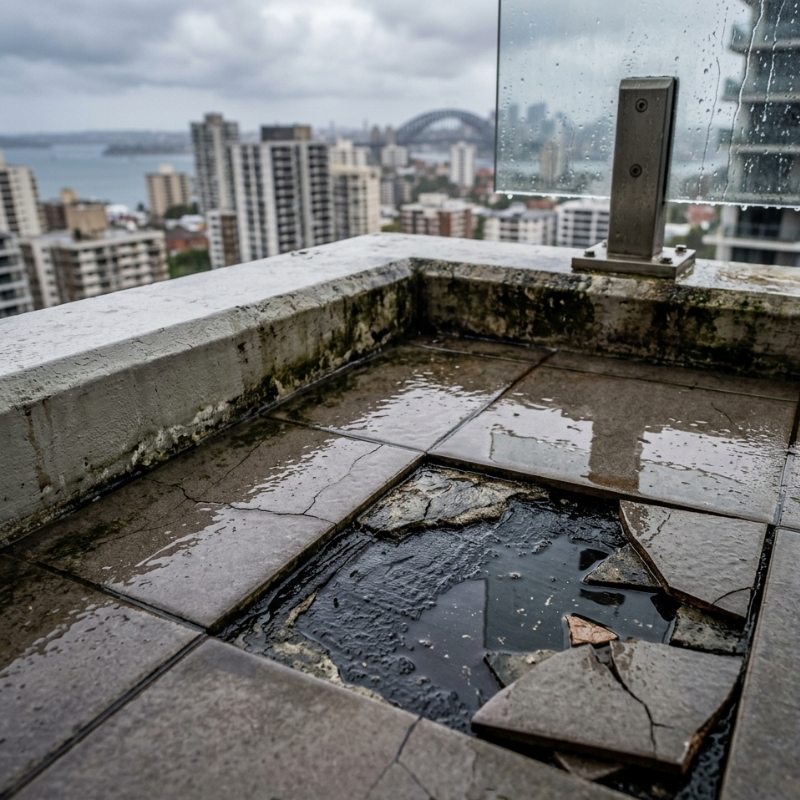
Sydney’s stop-start rain can turn a minor balcony leak into swollen timber, damaged tiles and stubborn mould before you know it. If the membrane has failed, you have two main choices: pick up the roller and attempt a do-it-yourself repair, or call in a licensed tradesperson. Both paths look straightforward on YouTube, yet the real-world outcomes can be very different once wind-driven rain, UV exposure and strict NSW waterproofing standards are factored in. This guide walks through the practical pros and cons of each approach, compares typical lifespans, highlights compliance pitfalls and explains when it is safer to hand the project over to specialist balcony waterproofing help instead of tackling it alone.
1. What Makes Balcony Waterproofing Tricky in Sydney?
Balconies may seem simple slabs with tiles on top, but several local conditions make waterproofing failures surprisingly common.
Climate Pressure Points
• Heavy summer storms can dump 100 mm of rain in an afternoon, pushing water under loose tile edges.
• Intense UV breaks down cheaper acrylic membranes faster than in cooler regions.
• Sea spray in coastal suburbs adds salt, which can corrode reinforcing steel if moisture reaches the slab.
Construction Variables
• Balcony slabs often have minimal fall, so even a 2 mm lip at the doorway can cause ponding.
• Balustrade posts penetrate the membrane and become leak hotspots if gaskets fail.
• Many Sydney apartments use lightweight topping screeds that crack when the building moves, opening paths for water.
Because each balcony is a micro-climate of water, movement and UV, the application method and membrane choice must match both the structure and the weather. That sets the stage for the core comparison: DIY or professional.
2. DIY Balcony Waterproofing: What Looks Easy, What Goes Wrong
Doing it yourself feels appealing when the damage appears minor or strata budgets are tight. Hardware stores sell roll-on membranes and primers, and instructional videos make the process seem no harder than painting a wall. Yet small mis-steps often undo the effort.
Common DIY Misconceptions
- “One coat is enough.” Most products require two or even three coats at the correct thickness.
- “Any primer will do.” Membranes bond poorly to dusty screeds or glossy tiles without the right primer.
- “I can waterproof over cracks.” Active cracks need to be bridged with fabric or bandage tape first.
- “Silicone seals everything.” Balcony junctions usually need polyurethane or specialised sealant compatible with the membrane chemistry.
Hidden Costs of a DIY Approach
While you might save on labour, extra expenses creep in:
• Buying rollers, buckets, spiked shoes for wet membrane, tape and specialised primers.
• Hiring a moisture meter or grinder to roughen a smooth slab.
• Rectifying fresh leaks that show up months later, often meaning tile removal and a second round of membrane.
Compliance Red Flags
NSW requires waterproofing work in a residential setting over 30 m², or worth more than $5,000, to be performed by a licensed waterproofer. Even under that threshold, strata by-laws or insurance policies may insist on proof of correct application. A DIY job that later leaks can void warranties on new tile installations and complicate insurance claims.
3. Professional Balcony Waterproofing: What You’re Really Paying For
Hiring a licensed contractor adds call-out and labour fees, but those costs cover more than someone rolling on a membrane.
Technical Know-How
• Selecting between sheet, liquid polyurethane, cementitious or hybrid membranes based on movement, sunlight and traffic.
• Testing moisture in the slab before application to avoid blistering.
• Forming a uniform 1.5–2 mm dry film thickness, which is harder than it sounds on a windy Sydney day.
Warranty and Accountability
Reputable waterproofers offer workmanship warranties and provide product datasheets for future reference. If a leak appears within the warranty window, labour and materials are generally covered.
Compliance Documentation
A licensed applicator issues a waterproofing certificate recognised by insurers, certifiers and local councils. This paperwork proves the membrane system meets the Building Code of Australia and NSW Home Building Act requirements.
4. Side-by-Side Comparison: DIY vs Professional at a Glance
The table below distils the core differences so you can see how each route stacks up before you commit.
Aspect D IY Approach Professional Approach
| Factor | DIY Waterproofing |
Professional Waterproofing
|
| Up-front spend | Lower on paper (materials only) |
Higher (labour + materials)
|
| Technical difficulty | Moderate to high, depends on substrate condition |
Handled by trained applicator
|
| Typical lifespan before repairs | 2–5 years if well applied |
8–15 years with suitable membrane
|
| Compliance & certification | No formal certificate, potential insurance issues |
Waterproofing certificate issued
|
| Risk of hidden leaks | Higher; pinholes and thin spots common |
Lower; membrane thickness is tested
|
| Warranty coverage | Manufacturer material warranty only |
Workmanship + material warranty
|
| Time & disruption | DIY learning curve, possible rework |
Usually quicker, scheduled completion
|
Resale/inspection confidence May raise questions during strata or pre-sale inspection Clear documentation satisfies buyers and strata
Even when the initial outlay for a professional seems steep, the longer lifespan and reduced rework often balance the ledger over a decade.
5. Key Compliance Considerations for NSW Homeowners
Waterproofing sits in a grey area for many DIY renovators who are comfortable painting or tiling. Yet the NSW Fair Trading Home Building Act treats balcony waterproofing as a specialised trade when the project value or area crosses certain thresholds. According to the NSW Fair Trading waterproofing guidance, unlicensed work that leaks can leave the owner liable for rectification and potential damage to units below.
Key points to remember:
• Work over $5,000 (labour and materials) requires a contractor licence.
• Strata schemes may demand licensed contractors regardless of value.
• Selling a property within the six-year statutory warranty period transfers responsibility for hidden defects to the seller.
6. How Longevity Really Differs: Not Just About the Membrane
It is tempting to believe the brand of membrane alone dictates lifespan, but application details matter just as much.
Membrane Thickness and Film Build
Professionals use wet-film gauges to check coverage. DIYers often miss corners or apply uneven coats, leading to early pin-holing.
Movement Joints
Sydney’s temperature swings cause slabs to expand and contract. Skipping bond-breaker tape at wall junctions places shear stress directly on the membrane, ripping it within seasons.
Surface Prep
Dust, laitance or efflorescence must be ground off before priming. A slippery sheen under the coating is a common DIY oversight that causes delamination.
When these factors are controlled, a balcony membrane can remain watertight for well over a decade; when they are ignored, leaks may reappear in as little as one heavy storm season.
7. Signs Your DIY Fix Isn’t Holding Up
Spotting trouble early means less invasive repairs. The practical checklist below helps you gauge whether the membrane you applied (or inherited) might be failing.
• Powdery white salts (efflorescence) appearing between tiles.
• Hairline cracks darkening after rain—moisture is tracking through.
• Persistent damp smell in the adjoining room.
• Paint bubbling on the ceiling below the balcony.
• Grout lines are going dark or mouldy despite cleaning.
If several of these show up at once, reviewing the installation approach and calling for expert advice on leaking balcony signs is usually the next sensible move.
8. Decision Framework: When Does DIY Make Sense?
DIY can work on very small, non-critical balconies when:
• Area is less than 4 m² and fully isolated from living spaces below.
• You can confirm the substrate is sound and dry.
• You are willing to follow the product datasheet to the letter.
• Future resale or strata approval is not a concern.
For all other situations—shared apartment balconies, over occupied rooms, or where long-term resale value matters—professional application tends to be the safer long-term bet.
9. Common Mistakes to Avoid Regardless of Who Does the Work
Even with a contractor on the job, owners should watch for these pitfalls:
• Tiling before the membrane cures—check the datasheet.
• Skipping flood-testing if the balcony is large or high-risk.
• Not sealing penetrations for electrical conduit or planter boxes added later.
• Ignoring balcony drainage; a perfect membrane can still pond water if the outlet blocks with leaves.
Documenting each step with photos and keeping product datasheets on file will help if questions arise years later.
10. FAQs
1. Is balcony waterproofing really mandatory in NSW?
While the Building Code of Australia sets performance requirements, NSW Fair Trading enforces licensing for work over certain values and areas. Even where unlicensed DIY is legal, insurers and strata bodies often require proof of correct membrane application.
2. Can I use a pool waterproofing product on my balcony?
Pool coatings are designed for constant water immersion, not foot traffic or UV exposure. Balcony systems must handle movement and sunlight, so using pool products generally voids warranties.
3. How long should a professionally installed balcony membrane last in Sydney?
With proper preparation and quality products, 8–15 years is common. Sheet systems can last longer if protected, while liquid membranes may need recoating sooner on high-traffic areas.
4. Will a DIY job always fail inspection when I sell my unit?
Not always, but an inspector may flag the lack of a waterproofing certificate. Buyers may then request a price reduction or insist on professional recertification as a condition of sale.
5. What is the biggest single cause of balcony leaks you see?
Poor detailing at wall junctions and penetrations. Even premium membranes fail quickly if bond-breaker tape or sealant transitions are skipped.
Wrapping Up
DIY balcony waterproofing can fix a minor issue if the stakes are low and the work is executed exactly to specification. For most Sydney properties, however, local climate stress, compliance requirements and long-term resale value tilt the scales toward professional installation. If you notice recurring damp spots, efflorescence or suspect the existing membrane is nearing the end of its life, arranging a qualified assessment now can save far more intrusive repairs down the track.


