

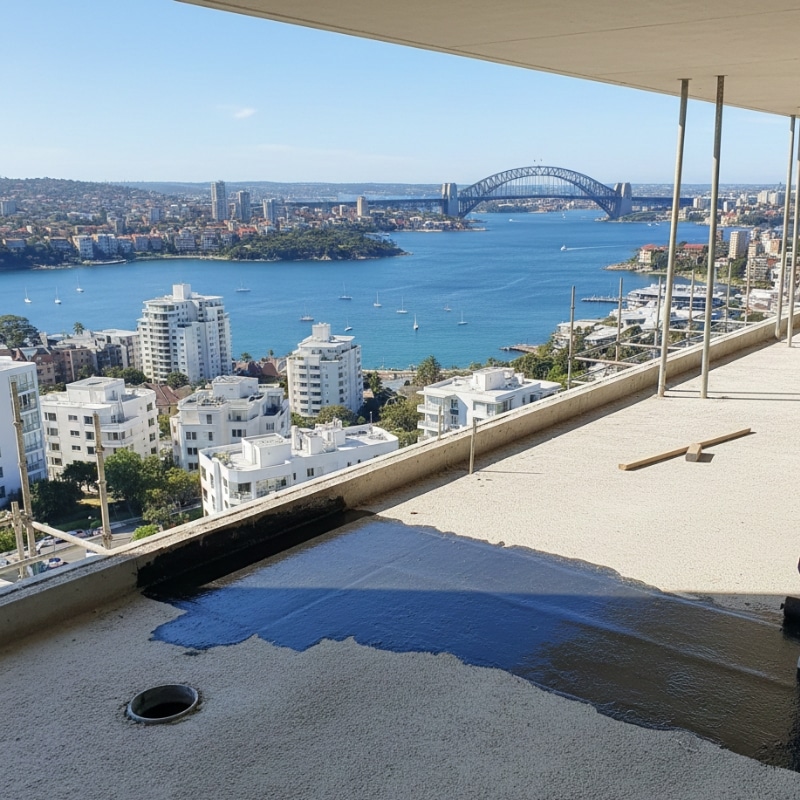
Apartment balconies are one of the most failure-prone areas in Sydney buildings, which is why balcony waterproofing must account for constant exposure to sun, wind-driven rain, salt air, and structural movement — conditions that mean the membrane system beneath the surface has to do far more than simply “keep water out”.
Poor products don’t cause many balcony leaks. They happen because the wrong membrane system was selected for the balcony’s conditions, or because critical detailing was overlooked during installation.
This guide explains how balcony membranes fail in Sydney apartments, how different membrane systems perform, and how owners, strata committees, and building managers can make better decisions that reduce repeat waterproofing problems.
Why Apartment Balcony Membranes Fail So Often in Sydney
Balconies in apartment buildings face challenges that don’t exist in internal wet areas or ground-level slabs. Understanding these pressures is essential before selecting any membrane system.
Environmental exposure is constant
Sydney balconies are exposed to:
• Strong UV radiation year-round
• Wind-driven rain during storms
• Salt air in coastal suburbs
• Rapid temperature changes between day and night
Unlike internal wet areas, balcony membranes must perform continuously under these conditions for years. UV degradation alone can embrittle some membranes, while salt air accelerates corrosion at fixings and penetrations.
These environmental pressures are a key reason balcony waterproofing in Sydney requires external-grade systems that are specifically designed for long-term exposure rather than general-purpose products.
Structural movement is unavoidable
Apartment buildings are dynamic structures. Over time, concrete slabs experience:
• Shrinkage during curing
• Thermal expansion and contraction
• Deflection under load
• Hairline cracking that widens with movement
When a membrane cannot stretch or bridge cracks effectively, it tends to fail first at stress points such as:
• Balcony edges
• Internal corners
• Junctions with walls
• Door thresholds
Movement tolerance is one of the most overlooked criteria when choosing a membrane, yet it is one of the most important for apartments.
Drainage and falls are often compromised
Many Sydney apartment balconies—particularly those built before modern standards—were constructed with:
• Minimal or incorrect falls
• Drain outlets positioned too high
• No secondary overflow points
Poor drainage allows water to pond on the surface. Even small amounts of standing water dramatically increase the pressure on the membrane and can force moisture into tiny defects over time.
Detailing matters more than the membrane brand
In investigations of leaking balconies, the membrane itself is rarely the sole cause. Failures most often occur at:
• Terminations and upturn heights
• Penetrations such as balustrade posts
• Bond breakers that were omitted or incorrectly installed
• Sliding door tracks and recessed thresholds
A high-quality membrane with poor detailing will fail faster than a modest system installed correctly.
Understanding the Main Balcony Membrane Types
Not all membrane systems behave the same way, and not all are suitable for every apartment balcony.
Sheet membranes (including torch-on systems)
Sheet membranes are factory-manufactured products supplied in rolls and bonded to the substrate.
Typical characteristics include:
• Controlled, uniform thickness
• Good resistance to puncture and abrasion
• Proven long-term performance when detailed correctly
However, sheet membranes can struggle with:
• Complex balcony layouts
• Tight corners and penetrations
• Low door thresholds where upturn heights are limited
In apartment settings with multiple penetrations, detailing becomes critical and labour-intensive.
Liquid-applied membranes
Liquid membranes are applied on site and cure into a seamless, fully bonded layer.
Key advantages include:
• Excellent adaptability around penetrations
• Seamless transitions at corners and junctions
• High crack-bridging capability when applied to the specification
Because they conform to the substrate, liquid systems are widely used in modern balcony waterproofing solutions, especially where balconies have irregular shapes or multiple services.
Their main weakness is inconsistency if:
• Thickness is not properly controlled
• Substrate preparation is rushed
• Weather conditions are ignored during application
Hybrid and trafficable systems
Some apartment balconies require membranes that can:
• Remain exposed without tiles
• Handle regular foot traffic
• Support pedestal pavers or lightweight finishes
These systems often involve multiple layers, including protection coats and wear surfaces, and must be carefully designed to avoid premature wear.
Why “Good” Membranes Still Fail on Apartment Balconies
Many balcony leaks occur even when reputable products are used. The causes are usually systemic rather than product-related.
Incorrect system selection
A membrane suitable for:
• Internal bathrooms
• Covered podium decks
• Roofs without regular foot traffic
may not survive on a fully exposed apartment balcony. Exposure class matters.
Poor substrate preparation
Before any membrane is applied, the substrate must be:
• Structurally sound
• Dry within specified limits
• Free of contaminants
• Properly profiled and primed
Failure to address cracks, laitance, or moisture is one of the most common reasons membranes delaminate.
Inadequate thickness control
Liquid membranes rely on achieving a minimum dry film thickness. Under-application leads to:
• Reduced waterproofing performance
• Lower crack-bridging ability
• Pinholes that allow slow water ingress
Thickness should be measured and documented, especially in regulated apartment projects.
Incompatible finishes and adhesives
The membrane, adhesive, screed, and tile system must be compatible as a complete assembly. Incompatibility can introduce shear forces that gradually tear the membrane apart beneath the finish.
How to Choose the Right Balcony Membrane for Sydney Apartments
Selecting the right system requires matching membrane performance to real-world conditions.
Consider exposure and location
Ask practical questions:
• Is the balcony near the coast?
• Does it face prevailing weather?
• Will the membrane be exposed to sunlight during its service life?
Balconies in eastern and northern Sydney suburbs often experience harsher UV and salt exposure than inland locations.
Assess structural movement risk
Older buildings and cantilevered balconies are more prone to movement. In these cases, membranes with higher elongation and crack-bridging capacity provide better long-term performance.
Review drainage and threshold constraints
Low door thresholds limit membrane build-up height and detailing options. In some cases, addressing waterproofing properly requires changes to:
• Drain positions
• Threshold detailing
• Balcony falls
Ignoring these constraints often leads to repeated failures.
Match the membrane to the finish
Different surface finishes place different demands on membranes:
• Tiles require strong bond compatibility
• Pedestal systems need robust protection layers
• Exposed finishes require UV-stable, trafficable systems
Documentation and compliance matter
Apartment balcony works in NSW often require design input, product data sheets, installation records, and inspection and sign-off in line with the National Construction Code waterproofing requirements:
• Product certification
• Installation records
• Inspection and testing
• Design practitioner involvement
This documentation protects owners and strata committees from future disputes.
Common Apartment Balcony Failure Scenarios (and Better Choices)
Re-tiling without removing the old membrane
Overlay systems can work only if the existing membrane is:
• Fully bonded
• Free of moisture
• Compatible with the new system
Otherwise, leaks often reappear within a few seasons.
Torch-on membranes at complex thresholds
Sheet membranes can struggle at recessed door tracks and curved upturns. Liquid systems often provide better continuity in these high-risk zones.
Ignoring balustrade penetrations
Balustrade fixings are among the most common leak points. Proper detailing must allow for:
• Movement
• Long-term sealing
• Corrosion protection
When to Escalate to a Specialist Assessment
Some situations require more than surface repairs:
• Persistent leaks after previous works
• Water ingress into internal apartments below
• Cracking combined with corrosion or spalling
• Repeated failures at the same locations
In these cases, a professional balcony waterproofing inspection helps determine whether the issue is membrane-related, structural, or drainage-based before further works proceed.
Balcony Waterproofing and Apartment Ownership in Sydney
Balcony leaks often involve overlapping responsibilities between lot owners and owners’ corporations. Understanding how membranes fail—and how systems differ—helps stakeholders make informed decisions.
For buildings experiencing ongoing problems, selecting appropriate balcony waterproofing solutions that address movement, detailing, and drainage together is far more effective than reactive patch repairs.
Frequently Asked Questions
What membrane is best for Sydney apartment balconies?
There is no universal answer. The best membrane depends on exposure, movement, drainage, and finish. Sydney balconies often require systems with strong UV resistance and crack-bridging performance.
Are liquid membranes better than sheet membranes?
Each has advantages. Liquid membranes excel at detailing, while sheet membranes offer controlled thickness. Installation quality and system selection matter more than type alone.
Can balcony membranes be installed without removing tiles?
Sometimes, but only when the existing system is sound, and moisture levels are acceptable. Overlay systems carry a higher risk if underlying defects remain.
Why do apartment balcony leaks keep coming back?
Most repeat leaks are caused by unresolved detailing, drainage issues, or membranes that cannot tolerate movement—not simply product failure.
Do strata buildings need special documentation?
Yes. Many balcony projects require documentation, inspections, and compliance records to meet NSW regulatory and strata requirements.
Final Thoughts
Balcony membranes in Sydney apartments fail most often because they are asked to perform beyond what they were designed for. Selecting a system that matches exposure, movement, detailing, and compliance requirements is the key to long-term success.
A careful, informed approach before works begin reduces the likelihood of repeat leaks, disputes, and costly remediation.


